
Web · Playable in browser
Breakover RC
RC crawling at full scale, in the browser.
A slow off-road crawler built on the RC crawling hobby. Drive a rock buggy or a scale truck over generated trails, take on ledges, logs, bogs, and slickrock, and tune the rig on a hobbyist's bench.
Playable at breakoverrc.com/play/.
By the numbers
- 3
- regions
- 18
- named courses
- 4
- rigs
- 3
- difficulty levels
Features
Three regions
Autumn Hills runs through wooded hills, creek valleys, and a stream, with fallen trees, bogs, and rock ledges. Juniper Rim is a sandstone rim above sandy washes, with slickrock domes, mesas, and fins. Spruce Coast is a fogged-in headland coast, with a beach under a bluff, spruce and hemlock forest, wet clay and gravel, river fords, and rock shelves at low tide.
Generated courses
Each region has six named courses. A course code and a difficulty always build the same layout, and Gentle, Standard, and Rugged change which obstacles a course carries.
Everything generated in code
Terrain, textures, plants, rigs, and sound are built at load time from code.
Four rigs
An offroad buggy, a trail truck, and a long-wheelbase version of each. Wheelbase, weight, and differentials decide which climbs and side slopes a rig handles.
Bodies to find
Each rig takes a body built for its own chassis. Four come with the rigs, twelve turn up at wreck sites, and four come only from barns. No body is sold in the shop. A wreck is a shell lying off the trail, on about one drive in three, and stopping beside it pulls the body whole. Mount points and sticker places come with the body, so a swap can change which parts fit.
Swapping bodies
Fit a different body and the bench asks what happens to what is on the old one. Keep everything with the new body, keep the fittings with the old shell in the bin, or send it all back to the bin. A rig's name belongs to the body on it.
Grails
Each region has its own set of seven rare parts, five rig parts plus a piece of driver wear and a piece of cargo, drawn from what that region is made of. Nothing in a set is sold. A Grail turns up only on a named course in its own region, at 2% odds at an easy obstacle and up to 6% at a built one, and most trade one strength for one weakness.
Barn finds
A barn turns up off the trail on about one drive in six, at the end of an overgrown two-track, and its building follows the region. It holds nothing by default, and its part roll and body roll run on their own, so an empty barn is the common case. A barn body arrives as a project that needs three of its own pieces found before it can go on a rig.
Build a rig from a chassis
A bare chassis turns up as a find on a course, or you can buy one for about a third of the price of a whole rig. It drives once the axles, wheels, motor, ESC, battery, and a body are on it. The bench lists what is still missing, and a factory piece comes off as a spare when an upgrade takes its place.
Winch
A winch bolts to a winch-ready bumper, and the line hooks to trees, rocks, logs, stumps, rock bolts, and ground anchors. The pull stalls at its rating rather than breaking the line, the drum lowers the rig under power, and free spool pays line out as the rig backs away. A log or a stump gives way under a full pull.
Extra Mile
A Rugged course has a second area past its edge, and one trail entrance leads to it. A stock rig stops on the entrance slab, a lightly built one rolls on the shelves inside, and four obstacles there take a winch. The summit earns a plate with the course's name on it.
Switchable lockers
Remote lockers put a servo on each axle, so the diffs switch while you drive. Both locked, front locked with the rear open, and both open are one press apart. Open turns tighter, and locked keeps both axles driving when a tire lifts.
Wheel wells
Openings are cut around the stock tire at ride height, the way an RC lexan body is cut. Bigger tires or a lift need trimmed wells instead, a free switch on the body in the Build tab that the build keeps while it needs it.
Wading
A stock rig swamps when water reaches the electronics in its tub, at about 0.9 m. Waterproof electronics seal the tub, and a sealed rig does not swamp at any depth. Buoyancy against weight decides the rest, so ballast is what keeps the tires down.
Crew
A driver figure kit from the shop or a figure found on a course gives you a person to build. A crew card opens Customize, with three body sliders over twelve preset bodies, eight faces, seventeen facial hair styles, fourteen hair styles, twelve skin tones, a wardrobe of tops, pants, footwear, and outer layers, and hats, glasses, and accessories to finish it, each layer in its own color. Any figure fits any seat, and in the driver's seat the hands go on the wheel. A figure adds 150 g at its seat, so who rides along changes how a rig balances.
Crew at camp
Arriving at a camp or an overlook stops the rig and fades to the place's name. The camera comes back on the rig parked off the trail and the crew in their places, in chairs and on the bench around the fire at a camp, standing at the edge at an overlook. Any input hands back the controls from where the rig was parked, and P plays the arrival again while you are stopped there. Figures you own but have not seated turn up at camps as campers, one or two to a camp and sometimes one of the characters, and with a free seat, F or a tap on a pad's left stick adds one to the crew.
Your other rigs
Another of your crewed builds stands parked at a camp or an overlook in about two drives in five. Stop beside it and press Z, or hold the left stick for a second, and you drive that rig on from where you are. The rig you left stays parked with its crew, and each build keeps its own crew and setup.
Found characters
Ten characters turn up as finds, from Bigfoot and a yeti to an alien, a lawn gnome, a skeleton, an astronaut, a scarecrow, a ninja, a robot, and a crash test dummy. Each has a fixed look with a few colors, any of them takes any seat, and only one you do not already own can turn up.
Cab decor
The interior brings seats, a dash, and a rearview mirror, and the decor hangs off it. Fifteen hangers go on the mirror one at a time, and 29 items go on the dash, from rubber ducks and a mini cactus to snow globes, a lava lamp, an alien bobblehead, and a Bigfoot figurine. Most sell in the shop for 15 to 45 credits and the rest turn up as finds.
A hobbyist's bench
Drive into the garage to swap the body, fit axles, gears, wheels, suspension, ballast, bumpers, protection, lights, cargo, and electronics, paint the body, put stickers and plates on the panels, and seat the crew. Every number on the bench is at model scale, so the rig and each corner read in RC kilograms, a part in grams, heights in millimetres, and payload against the rig's limit.
Parts to find
The shop sells most parts and restocks while you drive. Rare parts come only from finds, and some parts never appear in the shop at all.
Screenshots
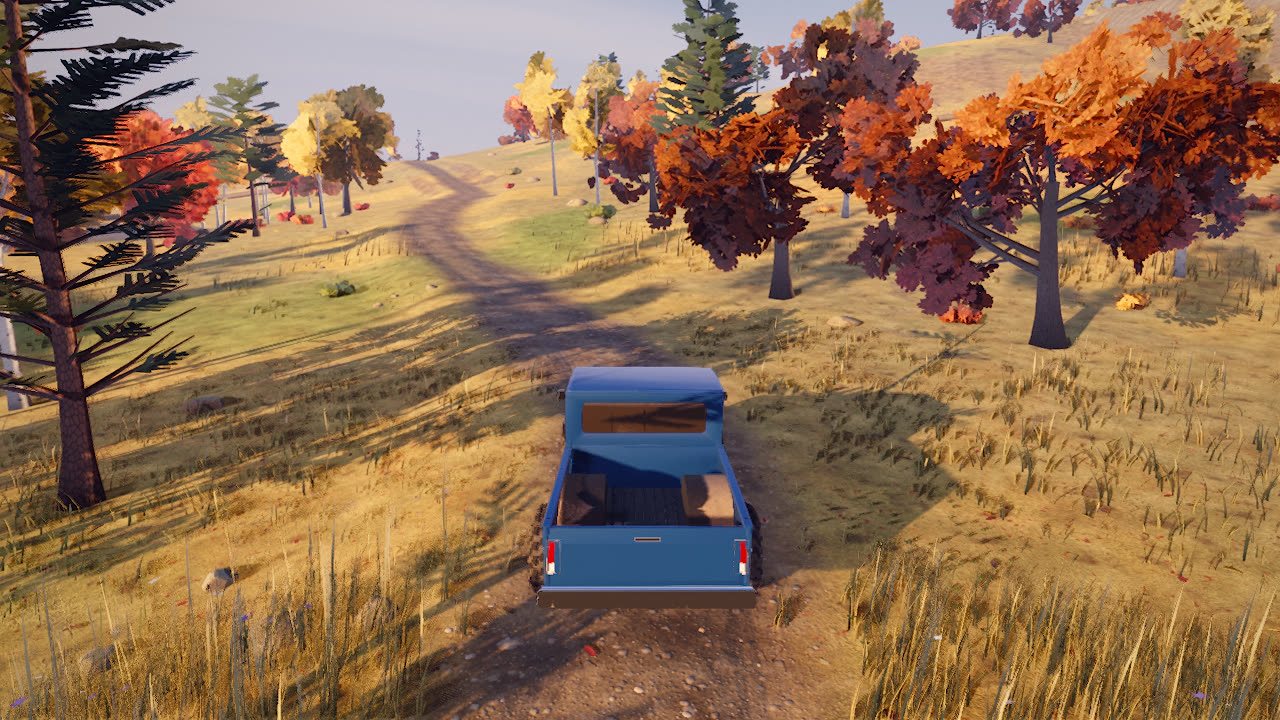
A trail truck on Autumn Hills 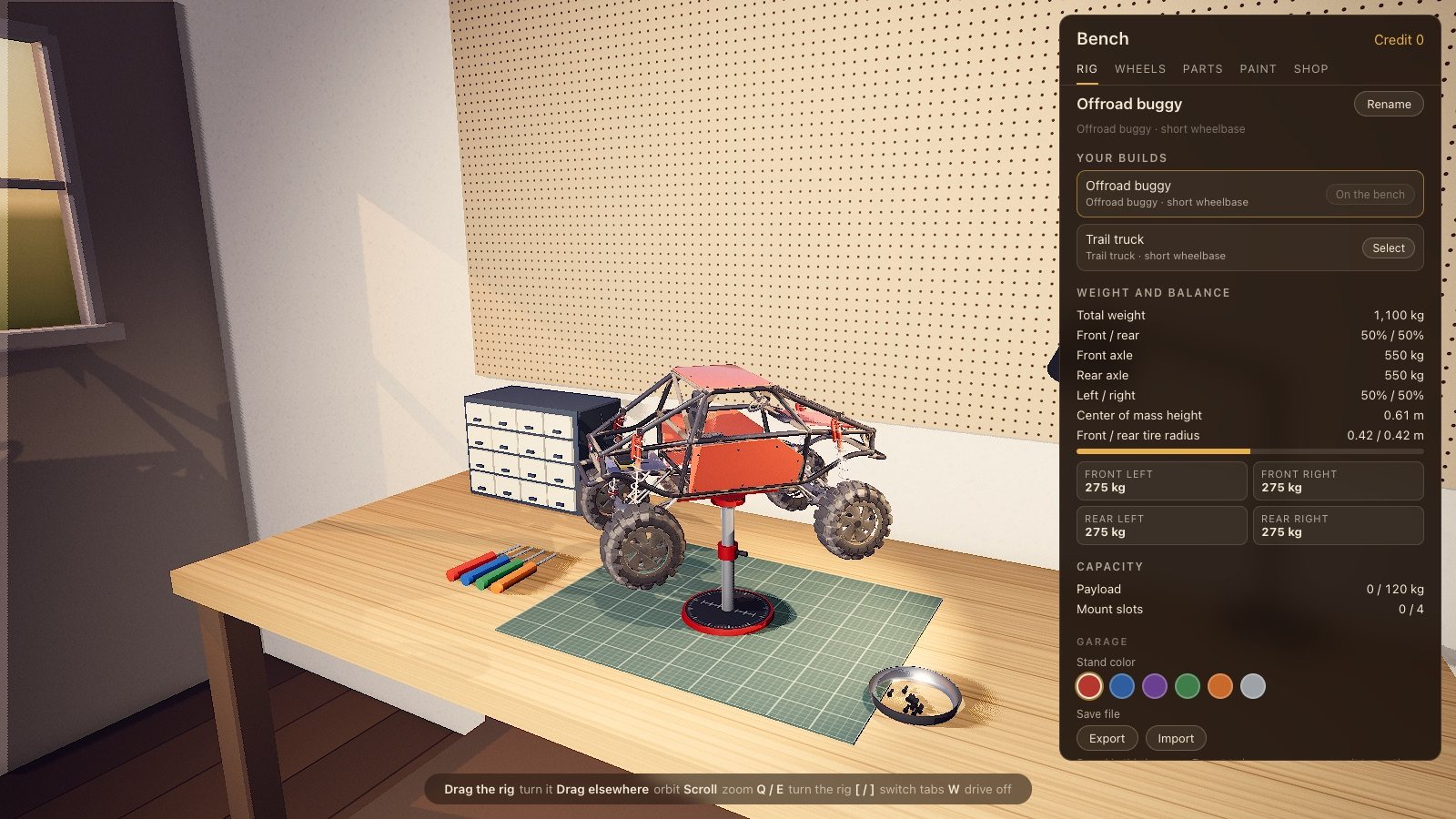
The garage bench 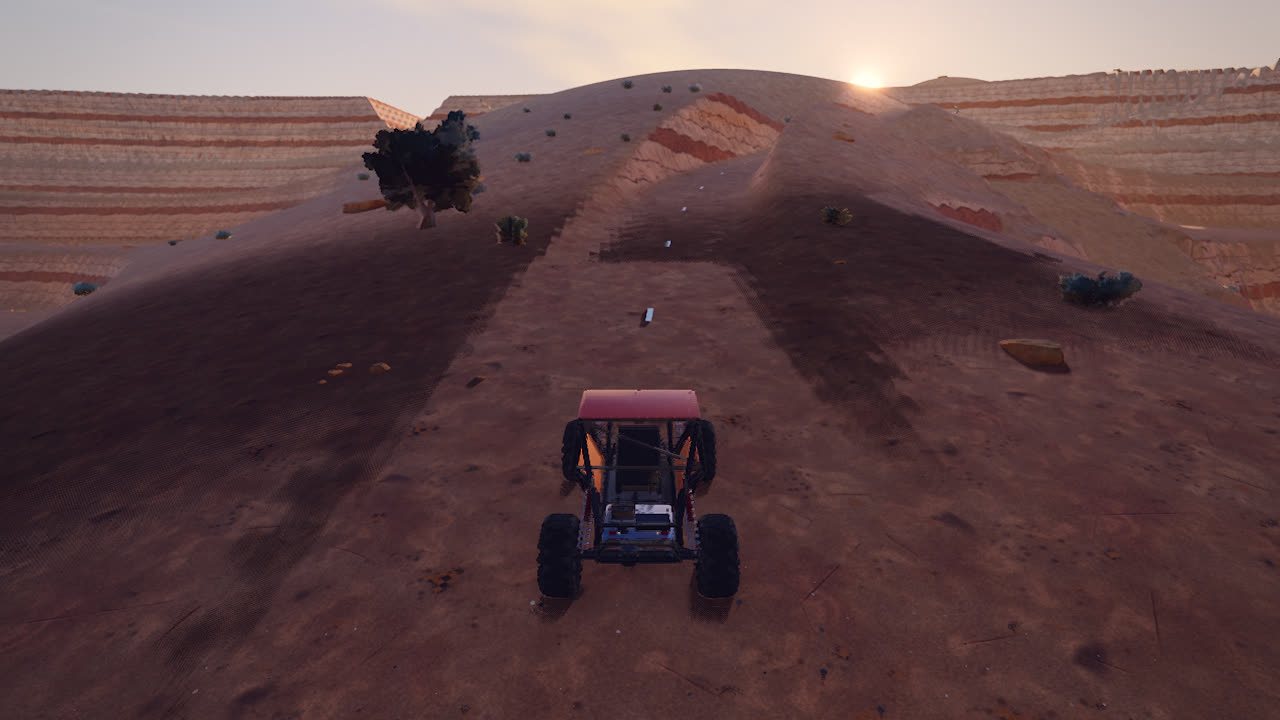
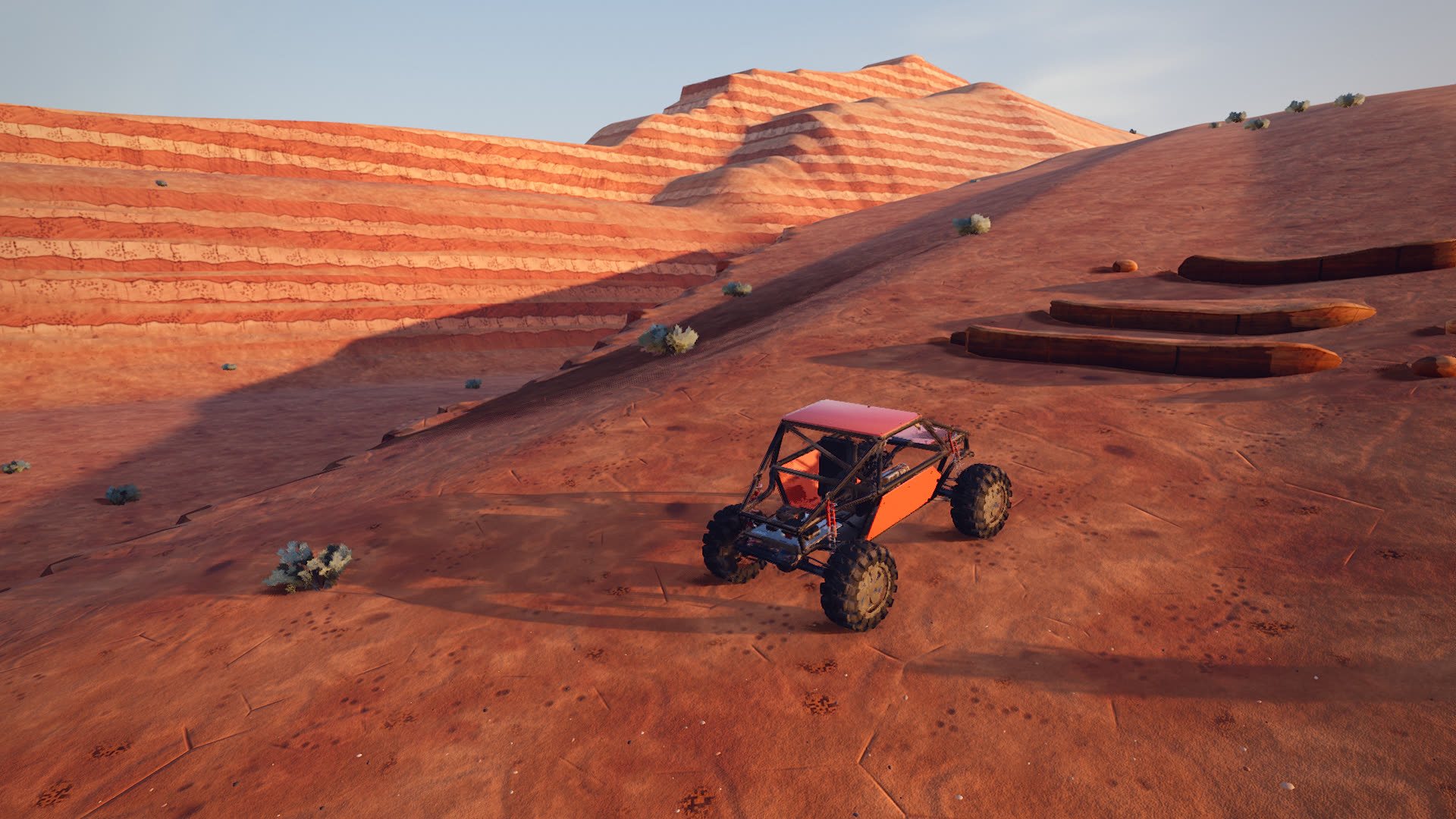
A rock buggy above a desert wash on Juniper Rim
The game runs in the browser at breakoverrc.com/play/. Pick a rig and a region, then follow the trail from the trailhead or leave it. Press R when the rig rolls or gets stuck.
A course in Breakover RC is a region, a number, and a difficulty, so the same code always builds the same trail. Autumn Hills runs through wooded hills and creek valleys with a stream. Juniper Rim is a sandstone rim above sandy washes, with slickrock domes, mesas, and fins. Spruce Coast keeps the sea along one edge: a sand beach 30 to 80 m wide under a bluff 15 to 40 m high, gullies cutting ramps up from it, headlands and rock shelves at low tide, and a river that reaches the sea in a gravel estuary. Every coast course’s trails touch the beach, and the region plays on traction rather than grade, with wet clay, soft sand, moss on rock, deadfall, and driftwood.
The garage carries the rest of the hobby. The bench is five tabs: Rig, Build, Look, Crew, and Shop. Rig holds the builds, the weight and balance, the garage wall, and Drive off. Build is the rig’s nine spots, from wheels and suspension to the cab and the electronics, with the weight strip at its root. Look is paint, weathering, stickers, and plates. Everything on the bench reads at model scale: the whole rig and each corner in RC kilograms, a part in grams, heights in millimetres, and payload against the rig’s limit. A part has to fit the selected rig and the mounts it needs. Buying one in the shop does not fit it. Where the part fits the rig on the bench, a Buy and fit button buys and fits it in one press. You can own more than one build of the same rig, each with its own body, parts, wheels, and paint.
Four bodies come with the rigs and twelve more turn up at wreck sites, from a flat-fender jeep and a compact pickup to a Baja bug and a hardtop jeep. None of them is sold in the shop, and each one brings its own mount points and sticker places, so a swap can change which parts fit.
A wreck is an old shell lying a little off the trail, and a drive has one about a third of the time, twice as often as a barn. Its look follows the region: moss and leaves in the hills, sand-blasted in a wash, washed up on the coast beach. Two wrecks in three hold a body you take whole and fit as it is, and the third gives up one part off the shell instead. Bodies no longer ride on the find cards.
Swapping a body asks what happens to what is on the old one. Keep everything with the new body and each fitting moves across where the new body has a mount for it, with the rest going to the bin; stickers, plates, crew, and paint stay as far as they fit. Keep the fittings with the old shell and it waits in the bin dressed and under its own name until you fit it again, while the crew get out and the chassis keeps its own parts. Send everything to the bin and the new body comes in bare in its own paint, with the choice of putting the chassis back to stock as well. A rig carries the name of the body on it, so a swap can rename the build.
Each region keeps seven Grails, rare parts that never appear in the shop. Five are rig parts, one is a piece of driver wear, and one is cargo, all taken from what that region is made of: Autumn Hills runs to maple-leaf paint, old green compound tires, bead-ring wheels, a leaf-spring conversion, brass owl-head knuckles, a buffalo-plaid flannel, and a crate of orchard apples. A Grail turns up only on a named course in its own region, at 2% odds at an easy obstacle and up to 6% at a built one, and most trade a strength for a weakness rather than beating everything. Finding one you already own pays half its value in credit, and the manual shows each region’s set as a question mark until a piece turns up.
Four bodies come only from barns: a power wagon, a troop carrier, a woodie wagon, and a rat roadster. The barn is a 1 in 6 roll on any drive, not a fixed place on a course, and what is inside rolls when the drive starts. The building follows the region: a red barn in Autumn Hills, a tin-roofed adobe shed on Juniper Rim, a cedar-shingle net shed on Spruce Coast. Half of the barns hold one uncommon or rare part, and a tire comes with a rim of its size as one wheel. A quarter hold a barn body you do not own yet, so a body turns up about one drive in 24, and the rest are empty. A barn body arrives as a project. Its grille, its glass, and its panels or trim are three separate finds, and they only roll while that project is open, so a piece is never wasted. Fit all three and the body is restored. From there it goes on a rig like any other found body. It comes back rusty with a heavy patina, and Look changes that.
Wheel openings are cut for the stock tire at ride height, so a normal bump stays inside the fender. Fit bigger tires or a lift and the shop and the Build tab both ask you to trim the wells first. Trimming is free and per build, and a build that needs the bigger openings keeps them.
A stock rig swamps from about 0.9 m of water, where the water reaches the electronics in the tub. Waterproof electronics seal the tub, and a sealed rig does not swamp at any depth. Depth then stops deciding anything. A sealed body and four tires push aside a lot of water, and what stops a sealed rig is running out of weight. At stock weight it crosses 2 m and floats off at 2.5, its tires carrying none of it. Ballast is what keeps the tires on the floor. The snorkel looks the part and changes nothing, since an electric rig draws its air from the sealed tub rather than the intake.
You can also build a rig up from a bare chassis, found on a course or bought from the shop. It drives once the axles, wheels, motor, ESC, battery, and a body are on it. Until then the bench lists what is missing, and the stand draws only what is fitted. Parts you take off one build, and the factory pieces an upgrade replaces, wait in the bin as spares.
The winch goes on a winch-ready or stubby winch bumper and carries 25 m of line. Trees, big rocks, logs, stumps, rock bolts, and ground anchors all take the hook. The nearest one in reach gets marked, and the HUD names it and its distance. On Gentle and Standard, some of the harder bogs and sand bowls carry a stake a few metres past the rim on the way out, so a stuck rig with a winch can pull itself clear. The winch pulls 1.8 times the rig’s weight and stalls there, the drum brake holds 2.7, and a log or a stump can pull loose under a full pull. Winching in climbs the rig out of something, powered line out lowers it over an edge, and free spool pays line out as the rig drives away.
On a Rugged course, a junction sign reads Extra Mile. Upgraded rigs. Behind it, a gully cut into the escarpment along the map’s edge opens into a separate 512 m area with no second way in. The region’s own landform composer builds the ground on a seed of its own, and one to three escarpments stand across it, each crossed by a single shelf that leans 32 degrees across the line over a 14 m twist. A stock rig stops partway up the entrance slab. Sticky tires and a brass diff cover get it up the slab, and the shelves inside roll it. A build with wide-track axles, droop straps, sliders, a skid plate, underdrive gears, and brass crosses every shelf but one, where a long truck stalls in the twist out of the lean.
Four obstacles inside need the winch: a 4 m rock face at 60 degrees that no tire climbs, a pit of mud 0.8 m deep in the autumn hills or 1.3 m of sand on the rim, a ravine 3 m deep and 15 m across that no rig jumps, lowered into from one rim and pulled out of from the other, and a 42 degree side-hold where the line holds the rig up against the lean. Each one carries its own bolts. Driven without the line, a near-fully-upgraded rig got through none of the 36 pieces on nine courses. On the line it got through all 36.
The map draws the connector as a dashed line from the start, then the area’s route and a cairn mark once the rig has been in. A reset inside puts the rig back at the nearest point of the stretch it is in, never past an obstacle. Arriving earns a plate lettered EXTRA MILE over the course’s name, one per named Rugged course, and it fits a rig’s plate spot for free.
Remote lockers put a servo on each axle and a three-position switch on its own binding, so the diffs change while you drive: both locked, front only, or both open. Open diffs turn tighter, and locked axles keep driving when a tire comes off the ground.
A driver figure kit from the shop, or a figure found on a course, gives you a person to build. Customize opens on a lit turntable with the figure at full height, and a rail of categories beside it: body, face, hair, skin, clothing, gear, outfits, and the pose and seat. Three sliders run height, build, and shape through the twelve preset bodies and past them. A face takes one of eight shapes, six noses, five eye shapes, five brow shapes, an eye color, and three sliders for chin length, face length, and brow ridge. A triangle under the shapes mixes three base heads. Facial hair runs seventeen styles, from short stubble to a bandholz. Hair is fourteen styles in ten colors, and a hat shows one of three shapes under it. Skin runs twelve tones.
Clothing is worn from the skin out: seven tops, four pants, work boots, hiking boots, sneakers, or rubber boots, work, fingerless, or winter gloves, and a jacket, a vest, a puffer, a fleece, or a rain shell over it, each layer in its own color. Ten hats and helmets, five pairs of glasses, three neck pieces, and four accessories go on top, and the accessories stack in any number. Every category has a lock, and Randomize builds a figure from the categories left open. The Outfits page starts from four built outfits and holds up to eight of your own. An outfit is clothes and gear only, so it dresses whatever figure it is put on, and each one can be renamed or deleted.
Any figure can sit in any seat, and the interior has to be fitted before there are seats to use. The driver sits with hands on the wheel, and in a front side seat with the glass down, the arm goes out the window. A seated figure adds 150 g at its place in the rig, so a passenger moves the balance around.
The crew get out at a stop. The first arrival at a camp or an overlook stops the rig and fades to the place’s name, then comes back on the rig parked off the trail with the crew in their places: chairs, the bench, and the fire at a camp, standing at the edge of an overlook. A slow camera move keeps the rig and the crew in frame with the view behind them. Any input hands back the controls from where the rig was parked, P plays the arrival again while you are stopped there, and on a pad it is Play this view again in the pause menu. Figures you own that are not in a seat turn up at camps as campers, one or two to a camp and sometimes one of the characters, and with a free seat, F or a tap on a pad’s left stick adds one to the crew.
One of your other crewed builds stands parked at a camp or an overlook in about two drives in five, once you have a second crewed build. Stop beside it and press Z, or hold the left stick for about a second, and you drive that rig on from there. The rig you stepped out of stays parked with its own crew, and the course, the clock, and your finds carry on. A find names the crew member who spotted it and shows their face.
Ten characters turn up as crew finds: Bigfoot, a yeti, an alien, a lawn gnome, a skeleton, an astronaut, a scarecrow, a ninja, a robot, and a crash test dummy. Their looks are fixed with a few colors each, and any of them can take any seat. A character find is always one you do not own yet, so the tenth is the last one, and Bigfoot only appears on courses where the rarest tier is open.
Decor hangs off the interior. Fifteen things go on the rearview mirror one at a time, from fuzzy dice and a pine air freshener to boxing gloves, a disco ball, a mini tire, a horseshoe, a little ghost, and an eight ball. The dash takes 29 items, among them rubber ducks (three at most), a mini cactus, a walkie-talkie, a folded map, a travel mug, a snow globe, a lava lamp, an alien bobblehead, and a Bigfoot figurine, with a CB microphone and a fan clipping to the dash edge. Most of it sells in the shop for 15 to 45 credits and the rest comes from finds. Hangers swing with the rig, the lantern and the lava lamp glow at night, the wind-up teeth chatter over bumps, and the fan blades spin as you drive.
Stickers and plates come from the keepsakes you earn on named courses. Look has a place for each slot, and the picker filters, sorts, and searches what you own. A sticker or plate sits in one place at a time, a drive holds two stickers and anything past that becomes a part instead, and finishing a course photographs the rig and its crew on the finish. The garage keeps the last ten of those on the Rig tab, under the wall, each one showing the course and who was riding.
Racks bolt to the rig’s mount points and add their own points on top, so roof lights need a rack first. Batteries raise top speed and peak torque: the stock NiMH pack is the baseline, a 2S LiPo adds about 30% top speed and 25% torque, and a 3S about 60% and 50%.
Terrain, textures, plants, rigs, and sound are all generated in code. The crew is the exception. The figures are sculpted once from MakeHuman body data and ship as their own geometry packs.